Thursday, 10 January 2013

Casio


Casio is the brand of Electronic keyboard, which HH Priya Nathji uses. Actually Casio Company was the first to promote Electronic keyboards on a large scale and they soon become popular all over the world. People actually started calling Electronic keyboards as Casio. The company name Casio become synonymous with the product. Besides Casio there were other companies also which make Electronic keyboards like Roland, Korg and Yamaha, but Casio was the company which popularized this product among the masses and professionals alike and for long, people associated Electronic keyboards only with Casio.
 HH Priya Nathji received a Casio from HH Pran Nath he had sent from London. That Casio was in the nature of a toy meant for children, and the sounds of the rhythm on it were very weak. That was infect, a model of the Casiotone series. Casiotone refers to a series of home electronic keyboards released by Casio Computer Co. in the early 1980s.
Most Casiotone keyboards were small, with miniature keys designed for children's fingers, and were not intended for use by professional musicians; they usually contained a rhythm generator, with several user-selectable rhythm patterns. Their low cost and abundance made them fairly common fixtures in garage rock bands all over the world. Then in late 1980’s Sudhir Saxena gave one of the greatest gifts that he could have given to HH Priya Nathji. He gave Him a Casio Keyboard, which was a more professional model from Casio. HH Priya Nath refers to the instrument as “Sudhir kaa baajaa” in the days that follow, whenever he tells Shri Nathji about his recordings. HH Priya Nathji loved this instrument. He still plays and records songs and gazals on a Casio electronic key board.
Casio Electric Keyboards are made by Casio Computer Co., Ltd. is a multinational electronics manufacturing company headquartered in Shibuya, Tokyo, Japan. Its products include calculators, mobile phones, cameras, musical instruments and watches. It was founded in 1946, and in 1957 released the world's first entirely electric compact calculator. In 1980 Casio released the Casiotone 201, its first electronic keyboard. As a compact and attractively priced unit that could play sounds from various instruments, this new product drew acclaim from music lovers around the world. Casio subsequently developed numerous features that were only possible using digital instrument technology, including one-touch auto-accompaniment, memory capacity to record and playback songs, auto-play, a melody guide function that guides users through a song by lighting up the keys, and sampling technology for recording any sound for use as a sound source.
Casio Electronic keyboards typically use MIDI signals to send and receive data, a standard format now universally used across most digital electronic musical instruments. MIDI messages would be sent when a note is pressed on the keyboard, and would determine which note is pressed and for how long. The values calculated by these sensors are then converted into MIDI data which gives a velocity value for each note, which is usually directly proportional to amplitude of the note when played. Thus it produced very accurate tones.

Amar Chand Qais


Amar Chand Qais was an old devotee of Shri Nathji from Lahore. He had become a famous poet after meeting Shri Nathji. Many years had passed and the man was now in dire straits. He had sent a beautiful poem in Homage to Shri Nathji as the Divine Being, and Shri Nathji had asked HH Priya Nath to preserve it carefully.
In 1988, Shri Nathji asks HH Priya Nath to send two hundred rupees to the poet and Priya Nath sends a money order to him. Shri Nathji notes ruefully how difficult it was for poets to earn money and how they lived in great poverty. Over the years Shri Nathji continued to remind HH Priya Nath to send two hundred rupees to Amar Chand Qais whenever he could. The poet remained ever grateful to Shri Nathji till the last moments of his life.
Amar Chand Qais (1902-94) was an Urdu poet. He was originally from Lahore, and latter settled in Jalandhar in Punjab. He is known in the world of Urdu poetry as Amar Chand Qais Jalandhari and also as Allama Kais Jalandhari. He is regarded as a poet of substance.  He was a great admirer of Mirza Ghalib.
Thought he was a Hindu, he is known for his beautiful “Naats” – Naat is poetry composed in praise of the Prophet Muhammad. He also specialized in a style of Islamic poetry known as Marsyia. The word “Marsyia” is derived from the Arabic word “Risa”, meaning a great tragedy or lamentation for a departed soul. It is an elegiac poem written to commemorate the martyrdom and valour of Hussain ibn Ali and his comrades of the Karbala.. It is usually in six-lined stanzas with the rhyme aaaabb. Amar Chand Qais poetry can be read in the few books of Urdu poetry like,  Ishq-e-Habib-e-Kibriya, by Mustafa Nazir Ahmad. This book (Whose photograph is given) is published by Saanj Publications at Lahore in Pakistan. This book has a collection of naats (poetry composed in praise of the Prophet Muhammad) by non-Muslim poets.

Monday, 7 January 2013

Bahadur Shah Zafar - T.V. Serial


In 1987, Shri Nathji and HH Priya Nath watch ‘Bahadur Shah Zafar’, a serial about the last Moghul Emperor of Delhi, who was more of a poet than a ruler. Shri Nathji watched the Ramayana in the mornings on Sundays, from his bedroom, and Bahadar Shah Zafar in the evenings, while sitting in the big room along with Priya Nath.
 Shri Nathji enjoys the serial which features Shri Nathji’s favourite actor, Ashok Kumar, in the leading role. Shri Nathji particularly enjoys the music and the Urdu ghazals in the film, some of which were written by Zafar himself.
Shri Nathji had in the past often quoted Zafar’s verses:
Ai Zafar usse aadmi na jaaniyegaa go ho kaisaa hi saahibo faimo zakaa,
Jisse aish men yaade Khudaa na rahi, jisse taish men kaufe Khudaa na rahaa
“O Zafar, call not such a person a man, no matter what his position or status,
Who remembers not God in comfort, nor fears God in wrath”
There was also the sad verse of Zafar which Mahamateshwari used to sing in Mussoorie in the late 1940’s:
“Na kisee ki aankh kaa noor hoon
Naa kissee ke dil ka karaar hoon
Jo kissee ke kaam na aa sake,
Main vo ek mushte gubaar hoon”
“I am not the sight of any eye,
Nor am I the comfort of any heart,
I am of no use to anyone,
I am that handful of dust”
An article on Bahadur Shah Zafar has already been posted in the blog, which can be viewed by clicking here.
Bahadur Shah Zafar, television serial way produced in the end of 1986. It was produced by B.R, Chopra and Ravi Chopra of B.R. Film Production Company. The acting of Ashok Kumar is this serial as Bahadur Shah Zafar is highly acclaimed. It has a total of 29 eposides. All of these can be viewed by clicking the following link.
We can see a famous episode from that serial bellow: -

Ramayana - T.V. Serial.


In 1987, when  the ‘Ramayana’ is being televised, Shri Nathji and HH Priya Nath watch it punctually every Sunday.  Shri Nathji reclines in his bed and watches from the inner window that opens into the big room. The television set has been placed on a tall table in the big room and is clearly visible to Shri Nathji. Mangla and Mrs. Taman and the others watch the serial in the big room.
There is the scene of Lord Rama eating the berries that Bhilnee gives him, after sucking them to make sure they are not sour. Lord Rama eats them despite the unhygienic mode of offering, such is His Love. Shri Nathji was watching His own past as Lord Rama, on the television.
Mrs. Taman feels that the Lord Rama of the television serial bears a striking resemblance to Shri Nathji in his mukat. However HH Priya Nath feels that Shri Nathji is much more beautiful than any actor playing Lord Rama.
Every Sunday Shri Nathji would set aside everything that he was doing and get ready to watch the Ramayana serial. Priya Nath would place the pillow behind his back while he reclined in his bed, facing the inner window of the room.  It was not that Shri Nathji was particularly fond of the serial, it was only because he thought Priya Nath liked it that he would watch it punctiliously with him. This was yet another aspect of Shri Nathji’s self-sacrificing nature, he would be ever ready to do anything for anyone in the world, even cater to the slightest of his whims, especially if the person was Priya Nath.
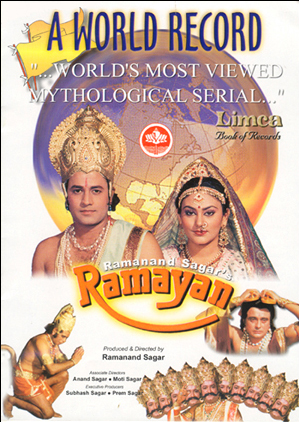
Ramayan is a highly successful and phenomenally popular Indian epic television series created, written, and directed by Ramanand Sagar. The 78 episode series originally aired weekly on Doordarshan from January 25, 1987, to July 31, 1988, on Sundays at 9:30 a.m. IST. It is a television adaptation of the ancient Indian Hindu religious epic of the same name and is primarily based on Valmiki's Ramayan and Tulsidas' Ramcharitmanas. It is also partly derived from portions of Kamban's Ramavataram and other works.
In 1986, following the moderate success of his television series Vikram aur Betaal and while he was in the midst of producing Dada-Dadi Ki Kahaniyan, Ramanand Sagar approached executives at Doordarshan about the possibility of producing a serialized version of the Ramayana, of which Sagar was a lifelong devotee. The idea was initially rejected, then revived, but delayed due to concerns that such a television series might lead to a rise in communalism. Finally, the show was indeed approved for 52 episodes (which would later be expanded twice in response to the series' overwhelming popularity, each time by 13 episodes, bringing the total to 78 episodes), and was given the unpopular time slot of Sunday morning at 9:30 a.m. Doordarshan budgeted Sagar, Rupees1 lakh per episode.
During its original broadcast, Ramayan was enormously popular, drawing over 100 million viewers. Although rising slowly at first, its popularity reached a point where the entire nation of India came to a virtual stop as nearly everyone who could gain access to a television stopped what they were doing to watch the televised adventures of Rama. In a phenomenon that the newsmagazine India Today dubbed Ramayan fever, religious services (Hindu and non-Hindu) were rescheduled to accommodate the show's broadcast; trains, buses, and inner-city trucks stopped running when the show was on; and, in villages, hundreds of people would gather around a single television set to watch the show.
At the time, Prime Minister of India Rajiv Gandhi stated, "Ramayan has stirred the imaginations of millions of viewers. It has imbibed the great Indian culture, tradition and normal values especially in the young."
While religious-themed films had been produced since the beginning of Indian cinema, Ramayan was the first Indian television series based on religious stories and is widely credited with inspiring the production of many other religious television series, most notably B. R. Chopra's Mahabharat. At the time it aired, Ramayan quickly rose to become the most popular programme in the history of Indian television and  the Limca Book of Records as the world's "most viewed mythological serial" until June, 2003.

Friday, 4 January 2013

Shri W. M. Kalmegh


Shri Kalmegh attended Shri Nathji’s lectures in Nagpur.  He attended Shri Nathji’s birthday celebrations on the 23rd of June 1979, at Dhanwate Rang Mandir, Nagpur. 
Shri W. M. Kalmegh was great academician of Vidarbha (Eastern Maharashtra) with a vision that transcended time and regional boundaries. He studied at the prestigious King Edward Memorial College  at Amravati, which was renamed as Vidarbha Mahavidyalaya after independence. He was given the respectable title of Dadasaheb. His zeal and enthusiasm is endorsed by the fact he was the elected president of one of the largest educational trusts- Shri Shivaji Education Society, Amravati that runs about 300 institutes in the region. His maturity of thoughts and the trust he instilled in fellow colleagues saw him taking the lead in initiating many path-breaking firsts in Nagpur University. His management acumen was recognized early on and catapulted him to become the youngest ever Vice Chancellor of Nagpur University, at a youthful age of 45 years.